
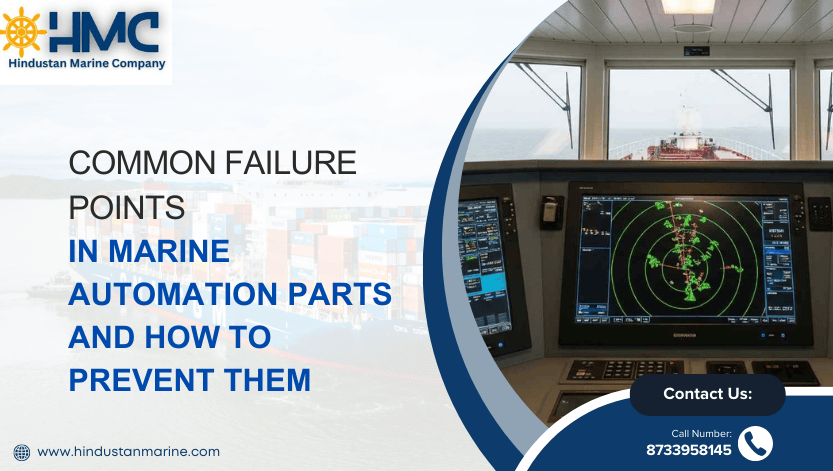
Modern ships are no longer just steel and engines — they are floating automation systems. From engine room monitoring and alarm systems to power management and navigation controls, marine automation parts run the show. But here’s the reality many shipowners and engineers in India face: automation failures are becoming more frequent, more expensive, and more disruptive.
Industry data shows that over 55–60% of vessel downtime today is linked to automation-related issues, not mechanical failures. Most of these breakdowns are preventable if the failure points are understood early.
At Hindustan Marine, we work closely with Indian shipowners, fleet managers, and engineers, and we see the same issues repeating again and again. Let’s break them down clearly and talk about how you can prevent them — practically, not theoretically.
Overview of Marine Automation Systems Used on Ships
Before jumping into failures, it’s important to understand where automation is actually used onboard:
- Engine Room Automation – Sensors, PLCs, monitoring panels
- Alarm & Monitoring Systems (AMS) – Fire, bilge, machinery alarms
- Power Management Systems (PMS) – Load sharing, blackout prevention
- Navigation & Bridge Automation – Integrated displays, data networks
- Deck Machinery Automation – Winches, cranes, steering, hydraulics
Each system depends on multiple marine automation parts, and failure in one part can impact the entire vessel.
Why Marine Automation Parts Fail So Often
Based on Indian vessel maintenance data and global marine studies:
- 45% of automation failures are sensor-related
- 25% are due to power supply or voltage fluctuations
- 20% are caused by PCB and control module damage
- 10% are linked to communication/network issues
The marine environment — heat, humidity, vibration, and salt — makes automation far more vulnerable than land-based systems.
1. Sensor Failures – The Most Common Weak Point
Sensors are the eyes and ears of ship automation systems, and unfortunately, they fail the most.
Common sensor issues:
- Pressure sensors giving wrong readings
- Temperature sensors drifting out of calibration
- Level sensors getting clogged or fouled
- Gas & fire sensors triggering false alarms
Why this happens:
- Oil contamination
- High vibration
- Improper installation
- Lack of calibration
📊 Stat: Nearly 1 in 2 automation alarms onboard Indian vessels are caused by faulty sensors, not actual system faults.
Prevention tips:
- Calibrate sensors every 6–12 months
- Use marine-grade sensors only
- Keep critical spare sensors onboard
- Buy from a trusted Marine Automation Parts Supplier like Hindustan Marine
2. PLC & Control Module Failures
PLCs are the brain of automation systems. When they fail, systems freeze or behave unpredictably.
Common PLC problems:
- Overheating inside control panels
- Software logic errors
- Communication loss with sensors
- Obsolete PLC models with no spares
📊 Stat: Around 30% of PLC failures are due to poor ventilation and panel overheating in engine rooms.
Prevention tips:
- Maintain proper panel cooling
- Keep software backups updated
- Avoid mixing incompatible PLC modules
- Replace obsolete PLCs before failure
3. PCB Failures Due to Marine Environment
PCBs are extremely sensitive to moisture and salt mist — both common on Indian vessels.
Common PCB failure causes:
- Humidity ingress
- Salt corrosion
- Loose solder joints from vibration
- Power surges during generator changeover
📊 Stat: PCBs exposed to humidity above 75% fail 2.5x faster than protected boards.
Prevention tips:
- Use conformal-coated PCBs
- Keep panels sealed and dry
- Install surge protection
- Replace repaired PCBs only if tested properly
4. HMI (Human Machine Interface) Display Failures
HMIs are where engineers interact with automation systems. When they fail, troubleshooting becomes difficult.
Common HMI issues:
- Touch screen not responding
- Display freezing or going blank
- Loss of communication with PLC
- Poor visibility due to aging screens
📊 Stat: Over 35% of reported “system failures” are actually HMI display faults, not real automation issues.
Prevention tips:
- Clean HMIs regularly
- Protect from heat and vibration
- Keep display backups configured
- Replace aging displays proactively
5. Power Supply & Electrical Failures
Automation systems are extremely sensitive to power quality.
Common power-related failures:
- SMPS failure
- Voltage spikes during generator switching
- Poor earthing
- Loose terminals and worn relays
📊 Stat: 1 out of every 4 automation failures happens during power changeover or blackout events.
Prevention tips:
- Install proper UPS for automation panels
- Check earthing regularly
- Replace aging SMPS units
- Tighten terminals during routine maintenance
6. Network & Communication Failures
Modern automation systems rely on communication protocols like CAN Bus, Modbus, Profinet, and Ethernet.
Common issues:
- Loose or damaged cables
- EMI interference
- Incorrect termination
- Mixing old and new protocols
📊 Stat: Network issues cause 20–25% delays during fault diagnosis onboard.
Prevention tips:
- Use marine-grade cables
- Proper cable routing and shielding
- Regular network health checks
- Keep spare communication modules
7. Alarm & Monitoring System Failures
Alarms are critical for safety, yet often ignored.
Common problems:
- Alarms not triggering
- Frequent false alarms
- Incorrect alarm configuration
- Crew ignoring alarms due to alarm fatigue
📊 Stat: Studies show 60% of marine incidents had prior alarm warnings that were missed or ignored.
Prevention tips:
- Test alarms regularly
- Remove redundant alarms
- Maintain alarm priority logic
- Train crew on alarm response
8. PMS (Power Management System) Failures
PMS failures can lead to total blackout — one of the most dangerous situations at sea.
PMS failure points:
- Load sharing malfunction
- Synchronisation module failure
- Faulty sensors feeding wrong data
- Software logic errors
📊 Stat: PMS-related blackouts account for 15–20% of emergency incidents on offshore vessels.
Prevention tips:
- Regular PMS testing
- Sensor redundancy
- Software validation after updates
- Keep critical PMS spares onboard
9. Human Errors That Cause Automation Failures
Not all failures are technical.
Common mistakes include:
- Incorrect parameter settings
- Improper cable termination
- Poor documentation
- Lack of crew training
📊 Stat: Human error contributes to nearly 35% of automation failures.
Prevention tips:
- Proper commissioning checks
- Training sessions for crew
- Clear documentation
- Support from an experienced Marine Automation Parts Supplier
10. Preventive Maintenance – The Best Defence
A simple preventive approach can reduce failures by 40–60%.
Basic checklist:
- Daily: Alarm & display checks
- Weekly: Sensor inspection
- Monthly: Panel cleaning & terminal checks
- Quarterly: Calibration & backups
- Annual: Full automation audit
At Hindustan Marine, we strongly recommend preventive maintenance contracts to avoid emergency breakdowns.
Why Choosing the Right Marine Automation Parts Supplier Matters
Working with the right supplier is as important as the parts themselves.
Benefits of choosing Hindustan Marine:
- Genuine, marine-grade automation parts
- Faster delivery across Indian ports
- Support for legacy and new systems
- Technical guidance & troubleshooting
- Better spare planning and cost control
A reliable Marine Automation Parts Supplier helps you prevent failures, not just fix them.
Conclusion
Marine automation failures are not random — they follow patterns. Sensors, PLCs, PCBs, power supplies, and networks are the most common failure points. The good news is that most of these failures are predictable and preventable.
With the right maintenance approach, trained crew, and support from an experienced partner like Hindustan Marine, shipowners in India can drastically reduce downtime, improve safety, and extend the life of their automation systems.
Frequently Asked Questions (FAQs)
1. What are the most common marine automation part failures?
Sensor failures, PLC overheating, PCB corrosion, and power supply issues are the most common.
2. How often should marine automation systems be checked?
Basic checks daily, detailed inspection monthly, and full audits annually.
3. Why do sensors fail so frequently on ships?
Because of vibration, oil contamination, humidity, and lack of calibration.
4. Can automation failures cause vessel blackout?
Yes. PMS and power automation failures are a major cause of blackouts.
5. Why is choosing the right Marine Automation Parts Supplier important?
Because quality parts, technical support, and fast availability reduce failures and downtime.

 Fast Delivery
 Easy Returns
 Instant Quote
 Product Demo